
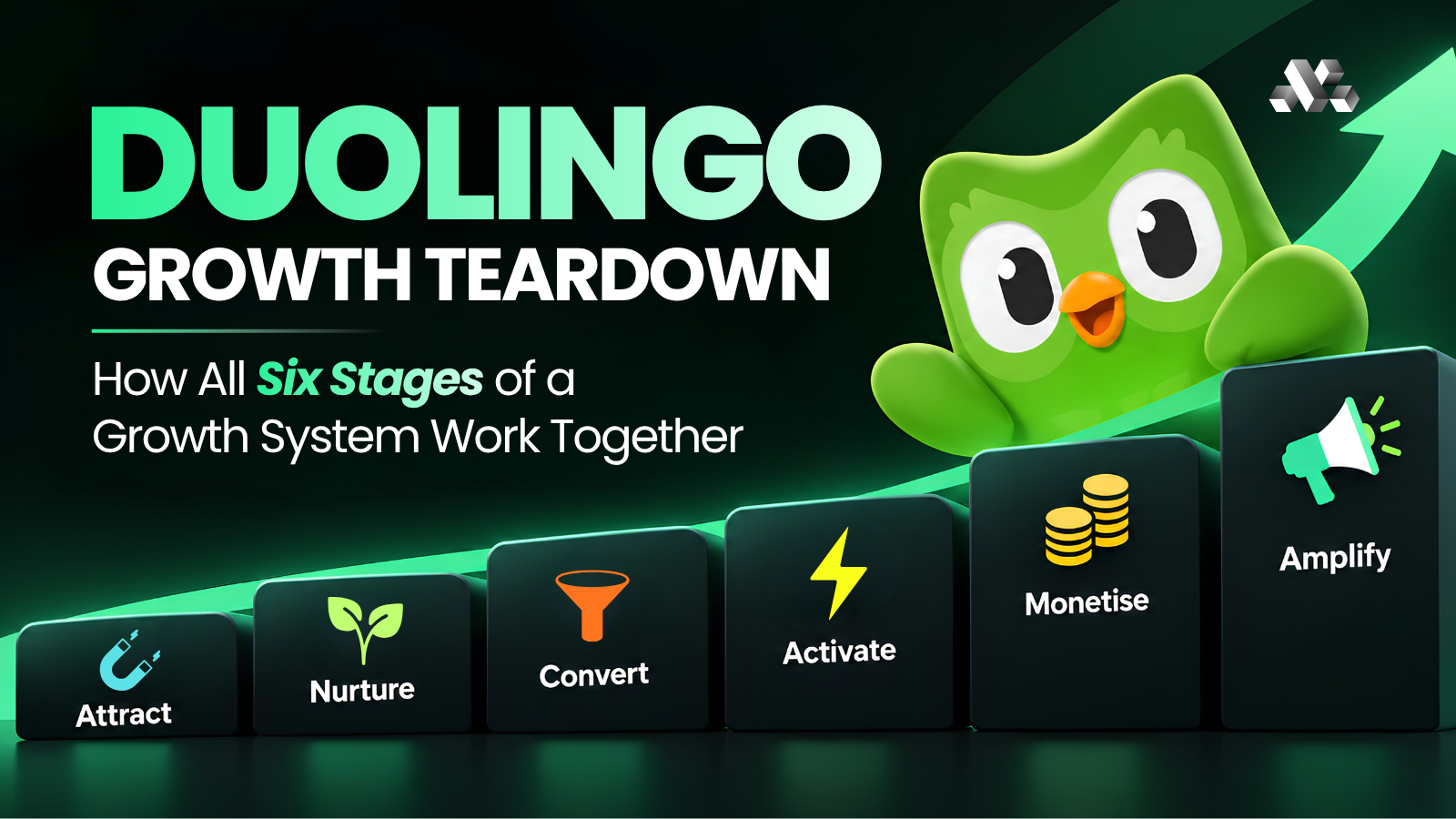
Duolingo grew its daily active users by 29% in a year, to 64.9 million, by building growth into every stage of the customer journey, not just its marketing. It's one of the clearest public examples of what a Full Stack Growth System looks like when all six stages work together.
(This is our analysis of publicly available information. Magnet doesn't work with Duolingo.)
Here's How Each Stage Works For Them, And What You Can Take From It For Your Own Business
- Attract: Make The Product And The Brand Do The Work
For years, almost all of Duolingo's new users came for free. Its former Chief Product Officer, Jorge Mazal, wrote that before 2018 all of its new-user acquisition was organic. Later, the bets that worked included expanding internationally, influencers, schools and going viral on TikTok, with only a small investment in paid ads.
It's still finding new ways in. In 2026, Duo the owl appeared inside two popular mobile games, Brawl Stars and Eggy Party, which the company says brought in millions of new and returning users.
The lesson: paid ads weren't the engine. A free product people talk about and a character people recognise did most of the work.
- Nurture: Give People A Reason To Come Back Every Day
Duolingo's streak, the count of days in a row you've practised, is its best-known feature. According to Mazal, the first big win for its retention team was a notification reminding people to save their streak. Over four years, the share of daily users with a streak of seven days or more nearly tripled, to more than half.
Just as important is what it didn't do. The team was told to "protect the channel". It couldn't send more notifications without a strong reason and sign-off from the CEO, because sending too many trains people to ignore you.
In 2026 it's still the main lever. The company says hundreds of experiments on notifications and streaks helped speed up user growth this year.
The lesson: nurture isn't sending more messages. It's giving people a habit worth keeping, and only messaging when it helps them keep it.
- Convert: Ask For Money After The Habit, Not Before
Duolingo doesn't ask new users to pay on day one. People learn for free, build a streak, and are offered a paid plan once they're already invested. It now has 13.1 million paid subscribers.
The lesson: most businesses try to convert people before they've had any value. Duolingo converts people who already use it every day.
- Activate: Let People Get Value Before You Ask For Anything
New users start a lesson before they're asked to create an account. Growth agency NoGood reports that when Duolingo tested letting people learn first and sign up later, daily active users went up 20%.
Leaderboards work the same way. Mazal wrote that they were designed to be as easy as possible: everyone is opted in automatically, and you can reach the top of the first league just by studying regularly.
The lesson: the faster someone gets a small win, the more likely they are to stay. Every form, step or question before that win is a place people leave.
- Monetise: Grow The Base First, Then Earn More From It
This year Duolingo made a bold call. In February it said it would put user growth ahead of making money in 2026, giving up more than $50 million of bookings to do it. User growth then sped up from 23% in Q2 to 29% in Q3.
It's also simplifying what it sells. It's stopping new sales of its top Max plan, moving those subscribers to a Super family plan with the same features, and giving its AI Video Call feature to all Super subscribers by the end of 2026. On top of that, it's adding optional extras, like outfits for your avatar.
The lesson: monetising isn't just charging more. A bigger, more engaged customer base gives you more people to sell the next thing to.
- Amplify: Reward What Your Best Customers Actually Want
Not everything worked first time. Duolingo's first referral programme gave people a free month of its paid plan for inviting friends. It only added 3% more new users, because its most active users already paid, so the reward meant nothing to them.
What worked better was competition. Its leaderboards put you up against people at a similar level, not just friends. Learning time went up 17%, and the number of highly engaged learners tripled. Family plans now let paying users share with the people around them.
The lesson: if your referral reward isn't something your best customers want, they won't refer. Find what they care about and build around that.
What Happens When All Six Work Together
None of these stages would work as well on their own. Free attention brings people in. Streaks bring them back. The habit makes them willing to pay. Paying users get more features, which keeps them longer. Competition and sharing pull in the next wave.
That's the difference between growth tactics and a growth system. Mazal wrote that this kind of work helped Duolingo grow daily users 4.5 times over four years. And it's still compounding.
Most businesses put almost all of their effort into one stage, usually Attract. Duolingo shows what happens when every stage gets the same attention.
What To Copy This Week
You don't need Duolingo's budget to use the same ideas:
- Find your streak. What reason does a customer have to come back regularly? A check-in, a reorder, a progress update?
- Protect your channel. Send fewer, better messages. Every message that isn't useful trains people to ignore the next one.
- Give value before you ask. Let people try, see or get something before they fill in a form.
- Test small things, often. Duolingo's biggest wins came from hundreds of small experiments, not one big idea.
- Make referral rewards matter. Ask your best customers what they'd actually value.
If you want to see which stage of your growth is holding the rest back, our free Growth Audit reviews your current setup and shows where revenue may be leaking.