How The Activate Stage Stops Churn Before It Starts
Churn usually doesn’t start with a cancellation. Customers often show signs that they are pulling away before they actually leave.
They might use the product less, stop responding to the team, miss important milestones or stop making progress.
The Activate stage helps you spot those changes and deal with the problem before it turns into a cancellation.
In the Full Stack Growth System, Activate comes after Convert. Convert gets someone to buy. Activate focuses on what happens to that customer afterwards.
Churn Doesn’t Happen Overnight
By the time a customer cancels, the problem may have been there for weeks.
Maybe they stopped using the product. Maybe they started ignoring emails. Maybe they stopped attending meetings. Maybe they raised a problem and never got it resolved.
Then eventually they leave.
If all you look at is your monthly churn rate, you only see the final result. Look at what customers were doing before they left. That’s where the useful information is.
1. Know What Normal Looks Like
Before you can spot a problem, you need to know what a healthy customer looks like.
For a software company, that could mean:
- Logging in regularly
- Using important features
- Completing key actions
- Adding team members
- Reaching certain milestones
For a service business, it could mean:
- Attending meetings
- Responding to the team
- Sending information on time
- Reviewing work
- Moving towards an agreed outcome
You don’t need to track every single thing a customer does. Pick the behaviours that actually show they are using what they bought and making progress.
Those give you a baseline. Then you can spot when something changes.
2. Look For Changes, Not Just Low Activity
A customer who has always logged in once a week is different from a customer who used to log in every day and suddenly stops.
The change is what matters.
The same applies to a service business. If a client normally replies within a day and suddenly takes two weeks to respond, something may have changed.
Look for things like:
- Product usage suddenly dropping
- Important actions being missed
- Fewer interactions with the team
- Meetings being missed
- Progress slowing down
- Support requests increasing
- Response times getting longer
None of these automatically means a customer is going to leave. But they give you a reason to look closer.
3. Find Where The Change Started
Once you spot a change, find out when it started.
What happened before it? Was there a particular feature, step, meeting, deliverable or milestone where the customer started behaving differently?
Look across multiple customers too. If lots of customers become less active at the same point, there may be a problem with that part of the experience.
Maybe the product is confusing. Maybe the process takes too much effort. Maybe customers are waiting for something. Maybe there is a technical issue. Maybe the service is not delivering what customers expected.
You can’t fix the problem until you know where it starts.
4. Find Out Why They Are Pulling Away
A change in behaviour tells you that something is happening. It doesn’t tell you why.
A customer might stop using a product because they can’t figure out a feature. Another might be waiting for your team. Someone else might have stopped because they aren’t getting the result they expected.
They all look like inactive customers in your data. But they need completely different responses.
So don’t just send the same reminder every time activity drops. Talk to customers. Look at support requests. Read feedback. Check what happened in the account. Find the actual problem.
5. Fix The Problem While There Is Still Time
Once you know why a customer is pulling away, decide whether you can fix it.
Sometimes it’s straightforward.
A customer needs help. A technical issue needs fixing. Someone needs to explain what is happening. A team member needs to step in. Other times, the problem affects lots of customers.
If the same issue keeps appearing, changing the product or service may be more useful than trying to save customers one by one.
The point isn’t to convince someone to stay at all costs. It’s to fix the reason they are considering leaving when that reason is something you can actually control.
6. Make Sure Someone Acts On The Warning Sign
Finding churn signals isn’t useful if nothing happens afterwards. Decide what your team does when a customer shows a warning sign. It could be as simple as:

Some of this can be automated. For example, a system could flag a customer when their usage drops or they miss an important milestone.
But someone still needs to look at the account and work out what is going on. The response should depend on the problem. And once you have taken action, check whether it worked.
Did the customer become active again? Did they start progressing? Did the problem come back? Did they still leave?
That tells you whether the process is actually helping.
7. Look At Customers Who Already Left
Customers who have already churned can tell you what to watch for next time.
Take a group of customers who recently left. Look at what happened before they cancelled. When did their activity change? Did they stop doing something important? Did they raise a problem? Did communication slow down? Did anyone notice? Did anyone try to fix it?
Then compare them with customers who stayed. You may find the same pattern appearing again and again.
Maybe customers who leave usually become less active three weeks before cancelling. Maybe they stop using one particular feature. Maybe they start raising support issues.
Whatever the pattern is, you can start looking for it in your current customer base.
Build Churn Prevention Into Activate
You don’t need to predict exactly which customer will leave. You need to make sure the business can spot problems early.
The process is simple:
Know what healthy behaviour looks like → spot changes → find out why → act → measure the result
Over time, you learn which problems are linked to churn and which responses actually help.
Some customers will still leave. That’s normal.
But if customers keep leaving for the same reason and nobody notices until the cancellation comes through, there is a problem in the system.
How To Find Your Biggest Churn Risk
Start with customers who have already left. Compare them with customers who stayed and look for differences in their behaviour before the outcome.
Ask:
- What usually changes before a customer leaves?
- How long before cancellation does it change?
- Where does the change start?
- Do we know why it happens?
- What do we do when we see it?
- Does that response actually help?
You don't need a complicated churn model. Start with the customers you already have and the data you already collect.
Find the patterns. Then build a process around them.
Stop Waiting For The Cancellation
The Activate stage is about what happens after the sale.
Within the Full Stack Growth System, the stages are:
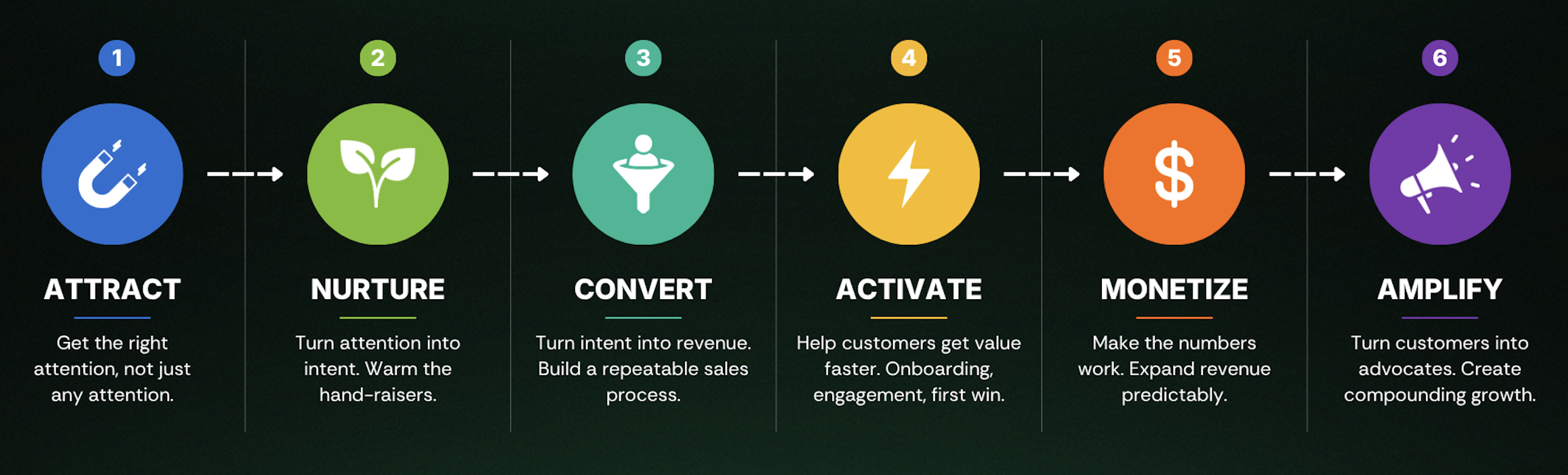
Attract brings people in. Nurture builds interest and trust. Convert gets them to buy.
Activate helps the business see what happens after that purchase, spot when customers start pulling away, and deal with problems before they become cancellations.
You can’t stop every customer from leaving. But you can stop waiting until they have already decided to go.
If you want to find where customers are becoming at risk and where your current growth system has gaps, a Growth Audit can help.