How To Increase Customer Lifetime Value
Getting a customer to buy is only the beginning. The next question is how much value you can generate from that customer over time.
That's what the Monetise stage is about.
Within the Full Stack Growth System, Monetise focuses on increasing customer lifetime value (LTV), improving unit economics, and making customer acquisition more profitable. This involves getting pricing and packaging right, creating relevant upsell and cross-sell opportunities, and understanding how much value each customer generates compared with the cost of acquiring them.
For example, if a customer buys once and never returns, the business only generates revenue from that initial purchase. But if the customer buys again, upgrades to a higher-value offer, or purchases an additional service, the total value of that relationship can increase.
The goal isn't simply to sell more. It's to build a business that generates more value from the customers it already attracts.
1. Pricing: Charge The Right Amount For Your Offer
Pricing has a direct impact on revenue, profit margins and customer lifetime value.
If prices are too low, a business may need to acquire a large number of customers just to cover its costs. That can make growth difficult, particularly when customer acquisition costs are high.
But raising prices without considering the value customers receive can make an offer harder to sell.
The aim is to find a price that reflects the value of the offer, makes sense for the target customer, and leaves enough margin for the business to grow.
Start by reviewing your current pricing:
- How much does it cost to deliver the product or service?
- How much does it cost to acquire each customer?
- What results or benefits does the customer receive?
- Is there enough margin left after the main costs are covered?
For a service business, this might mean reviewing whether the price reflects the expertise, delivery time and results involved.
For a software business, it could mean checking whether the pricing plans reflect the features and value available at each level.
Pricing should also support the wider growth strategy. A product that attracts plenty of customers but generates very little profit may make it difficult to reinvest in marketing.
The point isn't to charge as much as possible. It's to make sure the economics of the offer work.
2. Packaging: Give Customers A Reason To Choose More
Sometimes the issue isn't the price. It's how the offer is packaged.
Imagine a business selling a service for £500. Every customer receives the same package, regardless of their needs or budget.
Some customers may only need the core service. Others may want additional support, faster implementation or a more comprehensive solution.
Offering different packages can help serve those needs while creating opportunities to increase average order value.
For example, a service business might offer:
- Basic: The core service with essential support.
- Growth: The core service plus additional support and implementation.
- Premium: A more comprehensive service with greater access, support or customisation.
The exact packages will depend on the business. What matters is that each option offers a clear difference in value.
Good pricing and packaging make it easier for customers to choose the option that fits their needs. They also give customers who need more the opportunity to move to a higher-value package.
However, adding more features doesn't automatically make a package better. The additional value needs to be something customers actually want.
Review what customers ask for, which features they use, and what additional support they are willing to pay for. That information can help you build packages that make sense for both the customer and the business.
3. Upselling And Cross-Selling: Increase Customer Lifetime Value
One of the most effective ways to increase customer lifetime value is to create more opportunities to serve existing customers. That's where upselling and cross-selling come in.
- An upsell encourages a customer to choose a higher-value version of an offer. For example, someone using a basic software plan might upgrade to a plan with more features, higher usage limits or additional support.
- A cross-sell offers a complementary product or service that supports the customer's original purchase. For example, a customer buying a marketing service might also benefit from email automation, landing page development or lead follow-up systems.
Both strategies can increase revenue per customer without requiring the business to acquire an entirely new customer for every sale. But the offer needs to make sense.
A customer who has just bought a product may not need an upgrade immediately. They might benefit more from using the product first and being offered additional support once they understand what they need.
Look at the customer journey and ask:
- What do customers typically need after their first purchase?
- Which additional products or services would genuinely help them?
- When are customers most likely to need an upgrade?
- Are there opportunities for repeat purchases or ongoing services?
For a business with recurring customers, this might mean offering a relevant upgrade when a customer reaches a usage limit. For a service business, it could mean offering the next stage of support after the initial project is complete.
The aim is to make the next purchase a natural step in the customer relationship.
When done well, upselling and cross-selling can increase average order value, improve customer lifetime value and create more revenue from the customers the business has already acquired.
4. Understand The Numbers: Customer Acquisition Cost vs. Lifetime Value
More revenue doesn't automatically mean more profit.
To understand whether the Monetise stage is working, businesses need to look at customer acquisition cost (CAC) alongside customer lifetime value (LTV).
- Customer acquisition cost (CAC) is the average cost of acquiring a new customer. It can include advertising, marketing tools, sales costs and other expenses involved in bringing customers into the business.
- Customer lifetime value (LTV) measures the value generated by a customer over the course of the relationship. Depending on the calculation, this may refer to total revenue or the profit contribution generated by that customer.
These metrics help businesses understand whether the value generated from customers justifies the cost of acquiring them.
Consider this example.
A business spends £200 to acquire a customer. That customer makes an initial purchase worth £250. The business has generated £250 in revenue, but it hasn't necessarily made £50 in profit. It still needs to account for product delivery, payment processing and other costs.
Now imagine the customer returns and makes several additional purchases over the following year. The total revenue from that customer increases. If those purchases also generate a healthy contribution margin, the original acquisition cost becomes easier to justify.
This is why repeat purchases, retention and upsells matter. They can increase the value generated from customers the business has already paid to acquire.
Track CAC, average order value, repeat purchase rate and customer lifetime value. Where possible, also measure gross profit or contribution margin so you can see whether the additional revenue is actually improving profitability.
The relationship between CAC and LTV helps you understand whether your growth model is sustainable and where improvements could make the biggest difference.
5. Ad Spend Liquidation: Recover Customer Acquisition Costs Faster
Another part of the Monetise stage is ad spend liquidation.
The idea is to recover the cost of acquiring a customer as quickly as possible through the revenue and margin generated from that customer.
For example, imagine a business spends £100 on advertising to acquire a customer.
The customer initially buys a product for £50. The business has generated £50 in revenue, but it hasn't recovered the full £100 acquisition cost.
Now imagine the customer is also offered a relevant complementary product for £100 and chooses to buy it.
The total revenue from that customer is now £150. This brings the business closer to recovering its acquisition cost, although delivery costs and other expenses still need to be considered.
This is where upsells, cross-sells and post-purchase offers can help.
A business might offer a complementary product at checkout, introduce an upgrade after the first purchase, or recommend an additional service once the customer has received value from the original offer.
The objective isn't to push unnecessary products on customers. It's to identify relevant offers that increase the value of a purchase while helping the business recover its acquisition costs sooner.
Why does that matter?
When a business can recover its acquisition costs faster, it may be able to reinvest cash into acquiring more customers sooner. This can support growth without relying entirely on customers making purchases months later.
However, revenue alone doesn't prove that acquisition costs have been recovered profitably. Businesses need to account for the cost of delivering what they sell and measure the actual contribution from those sales.
The important thing is to understand how quickly each customer generates enough contribution to cover the cost of acquiring them.
How To Improve The Monetise Stage
You don't need to introduce every tactic at once. Start by looking at what customers are already buying and where you could offer them more value.
1. Review your pricing.
Check whether your current prices cover delivery costs, acquisition costs and the margin needed to run a sustainable business.
2. Improve your packaging.
Give customers clear options that reflect different needs and levels of value. Make sure the differences between packages are meaningful.
3. Identify upsell and cross-sell opportunities.
Look at what existing customers need next. Find relevant products, services or upgrades that help them get better results.
4. Measure customer lifetime value against acquisition cost.
Track CAC and LTV consistently. If possible, measure the profit contribution from each customer rather than relying on revenue alone.
5. Reduce the time it takes to recover acquisition costs.
If you use paid advertising, review the revenue and contribution margin generated after the initial purchase. Identify whether relevant additional offers could help customers generate more value sooner.
6. Test changes before scaling them.
Try one change at a time, such as introducing a new package or testing a relevant upsell. Measure the results to see whether it improves average order value, customer lifetime value or profitability.
The goal is to make decisions based on what customers actually buy and what the numbers show, rather than introducing more offers for the sake of it.
Make Every Customer Relationship More Valuable
The Monetise stage is about getting more value from the customers a business already attracts.
That means setting the right prices, packaging offers effectively, creating relevant upsell and cross-sell opportunities, and understanding the numbers behind profitable growth.
It also means looking beyond the first purchase. When customers continue buying because they receive genuine value, their lifetime value can increase without the business needing to acquire a new customer for every sale.
This is how Monetise fits into the Full Stack Growth System:
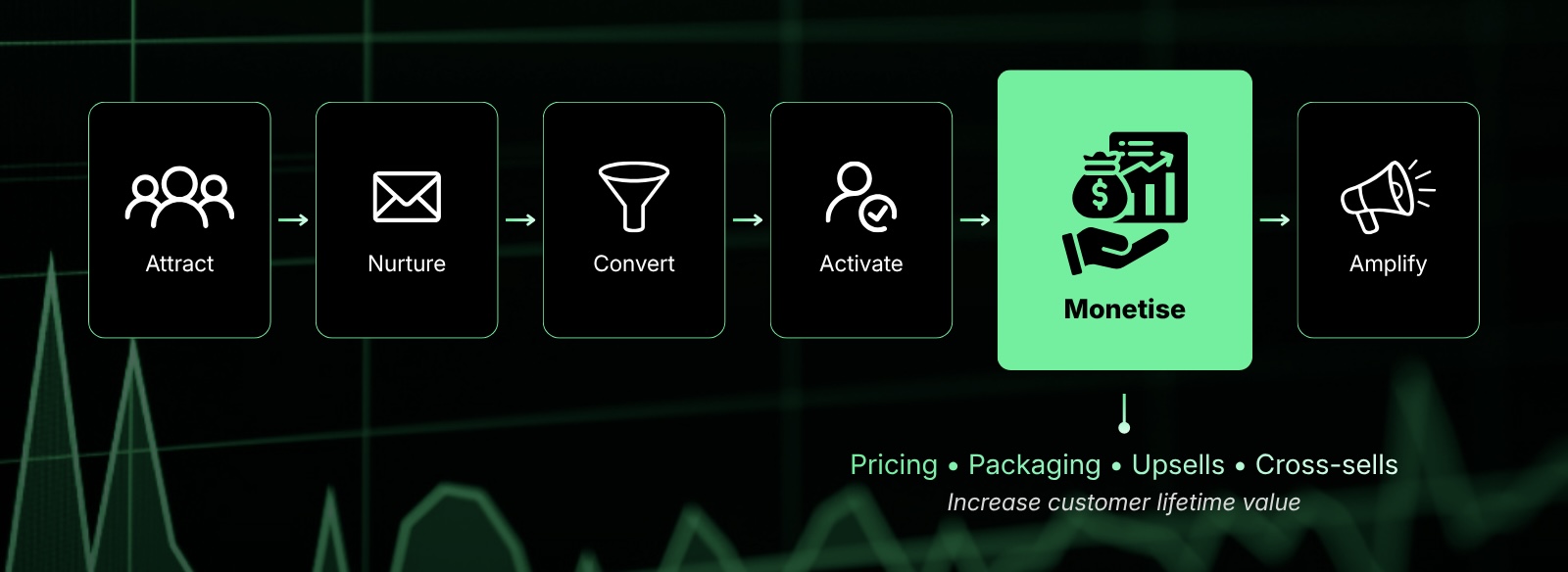
Attract brings the right people into the system. Nurture builds interest and trust. Convert turns that interest into a purchase. Activate helps customers get started and experience value. Monetise focuses on increasing the value of those customer relationships and making growth more profitable.
Each stage supports the next. But if a business only focuses on acquiring new customers and ignores what happens after the first sale, it may be leaving valuable revenue and profit opportunities on the table.
If you're not sure where your business is losing value after the sale, a Growth Audit can help identify opportunities to improve your current growth system.